Project
Real-Time Posture Correction Device
Media
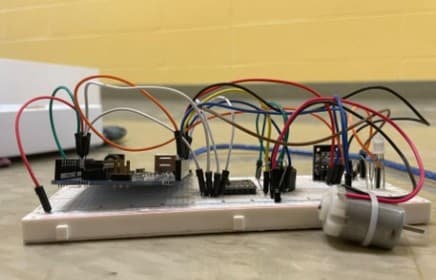
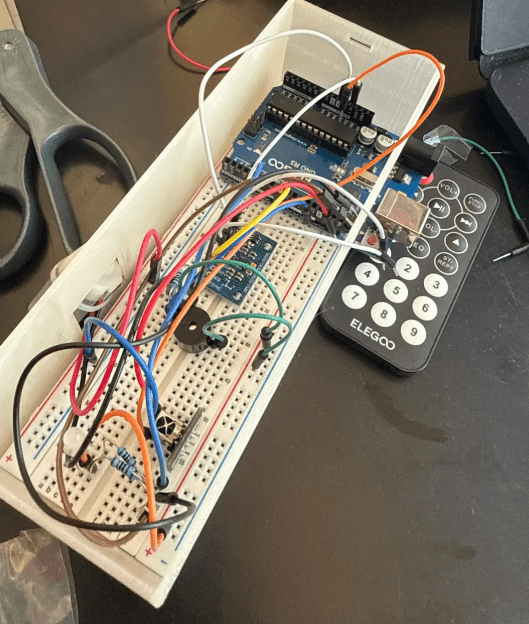
What is the project
I built a wearable real-time posture correction system using IMU sensing, embedded control logic, and multimodal feedback to reduce poor posture without restricting user movement.
- I started from a clear user problem: poor posture is widespread, but common correction methods are often expensive, uncomfortable, or hard to stick with long-term.
- The core sensing system uses an MPU9250 IMU to track pitch/tilt and continuously compare live posture against a user-defined baseline angle.
- I implemented real-time communication between the MPU9250 and an Elegoo Uno R3 over the I2C protocol, enabling continuous angle monitoring and threshold-based correction logic.
- The hardware control stage includes a PN2222A NPN transistor driver for the DC motor so high-current haptic output does not overload the microcontroller pins.
- I used 200-ohm current-limiting resistors for RGB LED channels and a 9V battery supply to keep the system portable while protecting sensitive components.
- When posture deviates by about 15 degrees or more, the device triggers multimodal feedback: audio via a KY-006 passive buzzer (PWM), haptic via DC motor vibration, and visual RGB LED status cues.
- An IR remote interface enables user-level control for power, buzzer volume, feedback mode selection, and baseline recalibration, making the device adaptable to individual biomechanics.
What I learned
- IMU-based posture correction depends heavily on calibration quality; baseline capture and drift-aware thresholding are critical for reducing false alerts.
- A robust embedded design needs proper power and driver staging, especially when combining low-power sensors with higher-current actuators in one portable system.
- Separating sensing, decision, and feedback layers in firmware made the system easier to tune and debug under real movement conditions.
- Personalization is a technical requirement, not just a UX preference: user-set baseline control materially improved response speed and correction effectiveness.
- In user testing, the device reduced poor-posture time significantly compared with control behavior and verbal-only feedback, validating the value of multimodal embedded intervention.
Skills Learned
- IMU Sensor Integration (MPU9250)
- I2C Embedded Communication
- Microcontroller Firmware Development (Arduino)
- Transistor Driver Circuit Design (PN2222A)
- PWM Audio Feedback Control
- Haptic Actuation Integration
- Portable Embedded Power Design
- IR Remote Interface Implementation
- Real-Time Thresholding and Calibration Logic
- Hardware-Software Co-Design